
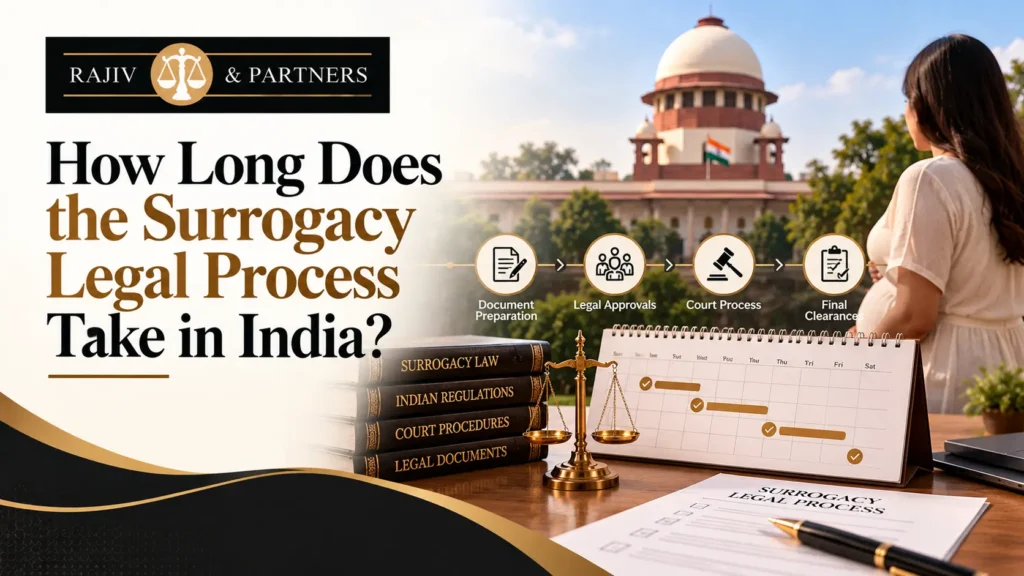
A practical guide for intending parents
For most couples, the question that comes right after “Can we do this?” is “How long will it take?” The honest answer: the legal and regulatory steps before an embryo transfer typically take two to five months, and the full journey from first application to holding a birth certificate usually takes 12 to 18 months. The exact figure depends on your State, your documents, and how smoothly each authority processes your file.
This article explains each stage, what can slow it down, and how to keep your case on track.
Why surrogacy in India involves several approvals
Surrogacy in India is regulated by the Surrogacy (Regulation) Act, 2021 and the rules framed under it. The law permits only altruistic surrogacy, with no payment beyond medical expenses and insurance cover. Because the process is tightly regulated, you cannot simply begin treatment at a clinic. Several certificates and a court order must be in place first, and each is issued by a different authority. That is why the timeline is a sequence of approvals rather than a single application.
Stage-by-stage timeline
The durations below are indicative estimates based on typical cases. Actual times vary between States and districts.
1. Certificate of Medical Indication (about 2 to 6 weeks)
The intending couple first applies to the District Medical Board, which certifies the medical reason why surrogacy is needed. Delays here usually come from incomplete medical records or difficulty scheduling the Board’s review.
2. Certificate of Essentiality and Certificate of Eligibility (about 1 to 3 months)
With the medical indication certificate, the couple applies to the State’s Appropriate Authority for a Certificate of Essentiality and a Certificate of Eligibility. The surrogate mother must also obtain her own eligibility certificate and give written informed consent.
This is the stage where timelines differ most. Some States have well-functioning authorities, while others have been slow to constitute Boards or process files. Courts have stepped in when applications stalled. For example, the Karnataka High Court has directed authorities to decide on a pending application within four weeks, and the Calcutta High Court in 2026 directed an eligibility certificate to be issued within seven working days in a case involving the age limit.
Keep in mind that an eligibility certificate has a limited validity period (generally one year), so a long delay later in the process can require renewal.
3. Order of parentage and custody from a Magistrate (about 2 to 8 weeks)
Before the procedure begins, the intending couple must obtain an order from a Magistrate of the First Class establishing parentage and custody of the child to be born. This order is what later allows the birth certificate to name the intending parents as the legal parents. A well-drafted petition with all supporting certificates attached avoids repeated hearings and adjournments.
4. Insurance for the surrogate mother (about 1 to 2 weeks)
The Act requires insurance coverage for the surrogate mother for the prescribed period, which covers pregnancy and post-delivery complications. This can usually be arranged in parallel with other steps.
5. Embryo transfer and pregnancy (about 1 to 2 months to confirm, then roughly 9 months)
Only a registered ART and surrogacy clinic may carry out the procedure. Embryo transfer may need more than one attempt, so allow for that in your planning. After a confirmed pregnancy, the term itself is roughly nine months.
6. Birth registration and post-birth documents (about 2 to 6 weeks)
After delivery, the hospital’s records and the Magistrate’s order are used to register the birth with the intending parents named as parents. If the family is an overseas Indian or foreign-based couple, passport and citizenship formalities for the child add further time.
Summary: how long does it take?
| Stage | Typical duration |
|---|---|
| Medical indication certificate | 2 to 6 weeks |
| Essentiality and eligibility certificates | 1 to 3 months |
| Magistrate’s parentage and custody order | 2 to 8 weeks |
| Surrogate insurance | 1 to 2 weeks (parallel) |
| Embryo transfer to confirmed pregnancy | 1 to 2 months or more |
| Pregnancy | About 9 months |
| Birth registration and documents | 2 to 6 weeks |
Legal approvals before the transfer: roughly 2 to 5 months. Entire process to birth certificate: roughly 12 to 18 months.
What commonly causes delays
- Incomplete or inconsistent documents. Mismatched names, missing medical reports, or unsigned consents are the most common reasons for an application being returned.
- State-level backlogs. Authorities in some States meet infrequently, which stretches the eligibility stage.
- Eligibility questions. Age limits, the status of existing children, and the relationship rules for the surrogate can all trigger scrutiny or rejection.
- Starting the medical process too early. Courts have held that the eligibility certificate must be obtained before the surrogacy procedure begins. Beginning treatment first can lead to rejection of the application.
- Court adjournments. The Magistrate stage can lengthen if the petition is incomplete or the surrogate’s spouse has not given the required consent.
- Expired certificates. Because certificates have a validity window, delays in one stage can force renewal of another.
Recent legal developments to be aware of
Surrogacy law is still evolving through court decisions. The Supreme Court has examined the age limits under the Act, including the position of couples who froze embryos and began the process before the Act came into force on 25 January 2022. High Courts have also considered how age is assessed when treatment started before the eligibility certificate was applied for. Because these rulings are fact-specific and the law is changing, it is important to have your situation reviewed against the latest position before you apply.
How to keep the process moving
- Confirm eligibility first. Check age, marital status, existing children, and the surrogate’s eligibility before spending on medical procedures.
- Prepare a complete document set for each application, with consistent names and dates.
- Sequence the steps correctly. Obtain all certificates and the Magistrate’s order before the embryo transfer.
- Run steps in parallel where the law allows, for example insurance and surrogate documentation.
- Track certificate validity so nothing expires mid-process.
- Work with an experienced surrogacy lawyer who knows how your State’s authority and local courts actually operate.
How legal counsel helps
A lawyer experienced in surrogacy can review your eligibility, prepare and file the applications, draft the Magistrate petition, follow up with the authorities, and move for court relief if an application is unreasonably delayed. Most importantly, they help you avoid procedural mistakes that cost months, such as an out-of-order sequence or a rejected file.
Frequently asked questions
Can the process be completed faster than 12 months?
Possibly. Once the pregnancy is confirmed, the nine-month term is fixed, so time savings come mainly from the approval stages and from a successful first embryo transfer.
What if the authority does not respond to my application?
You can follow up formally and, if the delay continues, a High Court petition can seek a direction to decide the application within a fixed time.
Is the Magistrate’s order needed before or after birth?
It is obtained before the surrogacy procedure and is relied on after birth to register the child under the intending parents’ names.
Do timelines differ between States?
Yes. The eligibility stage in particular depends on how active your State’s Appropriate Authority is.
Conclusion
The surrogacy legal process in India is structured and time-bound, but not instant. Plan for a few months of approvals before the medical procedure and around a year or more overall. Careful preparation, the right sequence, and professional legal guidance are the best ways to avoid avoidable delay.
If you are considering surrogacy and would like your documents and eligibility reviewed, contact the team at Rajiv & Partners for a consultation.
Disclaimer: This article is for general information only and is not legal advice. Laws, rules, and authority practices change, and every case is different. Please consult a qualified lawyer about your specific situation.

Advocate Rajiv Ranjan Shukla is a Delhi-based legal professional with an LL.B. from Campus Law Centre, University of Delhi, and an LL.M. from the Faculty of Law, University of Delhi. His practice covers criminal law, civil law, matrimonial and family law, medical negligence, IPR, corporate law, and surrogacy law.
With a practical approach to litigation and legal advisory, he focuses on understanding each client’s circumstances, providing clear legal guidance, and developing effective strategies to protect their rights and interests.